7 Line Marking Requirements for EV Charging Infrastructure
At a Glance
EV charging bays require more than installing chargers. Most car parks are not designed for the space, access, and flow EV use demands. Effective line marking ensures clear bay definition, accessibility, safe movement, durable visibility, and ongoing usability. Poor layout, weak materials, or lack of maintenance lead to congestion, misuse, and reduced efficiency.
Want to explore more? Call us now to discuss line marking requirements for EV charging bays or to schedule a site consultation.
Why Line Markings Matter for EV Charging Bays
Recent data from March 2026 shows that electric vehicle sales hit a record high, with more than 86,000 new registrations in a single month. Alongside this growth, government figures indicate there are now over 1.1 million fully electric cars on the roads. As capacity expands, pressure on supporting infrastructure is becoming more visible.
On many EV charging bays and sites, the issue is not the charger itself but how the surrounding space is organised.
Most existing car parks weren’t designed with EV charging in mind and their layouts and bay sizes were built for standard vehicle use. This means car parks that were not built for vehicles that need comparatively extra space to park, connect, charge and remain stationary for longer periods.
On-site, this causes inconvenience for the surrounding area, as EV bays require wider, slightly longer spaces. To ensure safe access and proper cable handling, we recommend increasing the typical bay size of 2.4 m x 4.6 m to around 3 m x 5 m.
This adjustment can have consequences, as fewer bays can be accommodated, adding pressure on traffic movement and possibly on circulation space. Plus, without a structured layout, sites can end up with blocked chargers and inefficient use of space.
Line marking plays a defining role here, as it does more than just outlining bays. It organises movement, clarifies space use and helps integrate EV charging into layouts that were never originally built for it. Well-planned EV charging areas take these constraints into account from the outset. They maintain clear routes, balance accessibility, follow recognised UK EV charging regulations and EV infrastructure compliance standards.
At Line Mark, we approach EV bay layouts exactly this way. We assess how the site currently operates, identify where space needs to be adapted and apply clear, durable markings that support both movement and usability, limiting disruption to the wider layout. On most sites, this is reflected through a set of practical requirements that guide how EV charging areas are laid out and maintained. Let’s take a closer look at them:
1. Clearly Defined EV Charging Bays
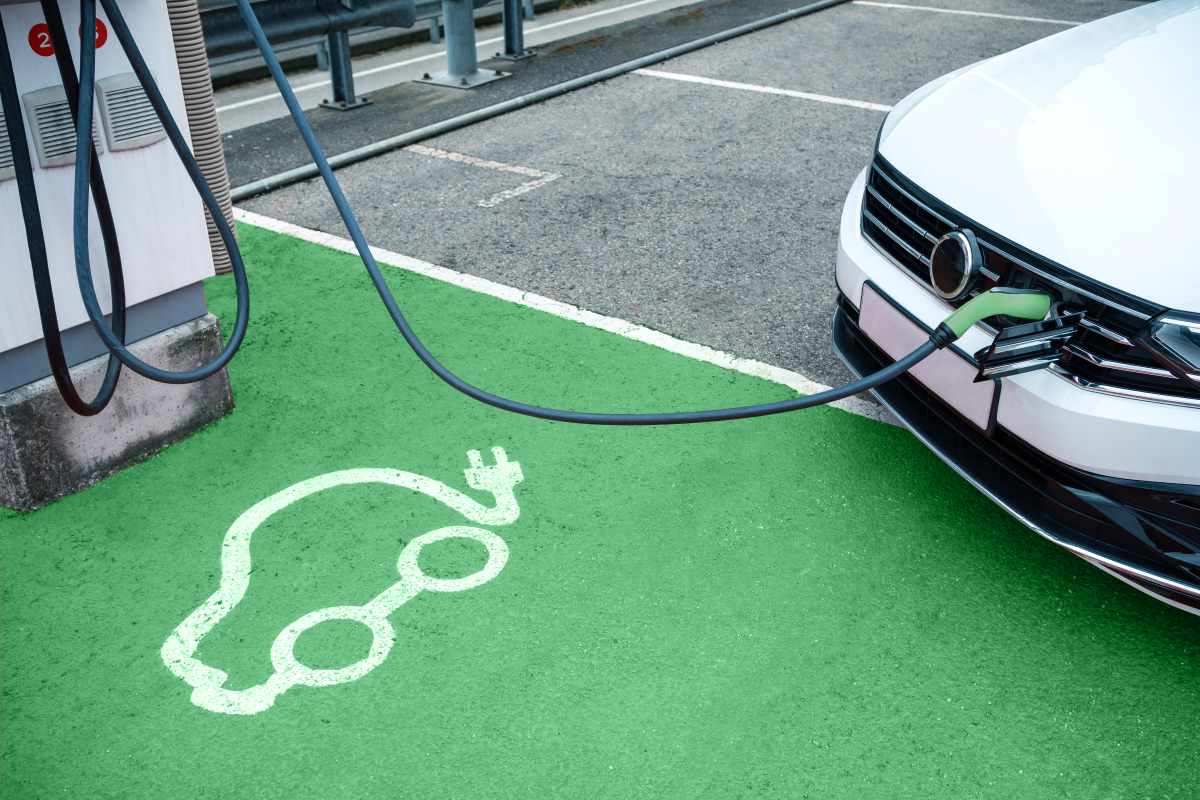
Clarity in EV charging bays is essential for usability. On private sites, there is no single legal standard dictating the exact EV bay markings. However, guidance consistently points towards using recognisable symbols, clear boundaries, high-contrast markings and consistent layouts so drivers can identify bays immediately.
In practice, this usually means having white bay lines to define the space, EV symbols or “EV only” text and using a contrasting colour, such as green, to differentiate the bay. The DfT research on EV symbols shows that recognisable symbols improve drivers’ understanding and reduce hesitation in busy environments. When planning how to mark EV charging spaces, the focus should always be on instant recognition.
2. Accessible and Inclusive Bay Markings
As EV charging areas are introduced into existing car parks, accessibility becomes a key consideration. These spaces need to work for a wider range of users, while still fitting into layouts that were not originally designed for them.
Guidance here becomes crucial, as standards such as PAS 1899 outline how public chargepoints should be designed for accessibility. It includes recommendations on space layouts and ease of movement around the vehicles. This is supported by UK EV charging regulations and expectations under the Equality Act 2010.
In the real world, this usually means wider bays, clear access zones around the vehicle, layouts that allow safe cable handling and enough room to move comfortably while handling charging cables. Just as importantly, these bays need to be immediately recognisable and easy to navigate.
On-site, that comes down to having simple, consistent marking choices. Accessible EV bays are generally finished in blue with a white EV symbol, so drivers can understand their purpose without hesitation. When applied correctly, it removes uncertainty and keeps the space functioning as intended.
3. Directional Marking for Safe Traffic Flow
EV charging areas don’t usually fit neatly into existing layouts, yet they are mostly added to car parks at a later stage. That’s where the flow starts to break down, as these car parks were never designed with charging infrastructure in mind. It is in such spaces that the line markings should easily guide behaviour.
Directional arrows, lane markings, symbols and clearly defined entry and exit points all help integrate EV bays into the wider layout. When properly marked, it meets all the line-marking requirements for EV charging bays and also aids vehicle movements through the space, reducing hesitation and unnecessary manoeuvring.
Without that guidance, safety can be jeopardised as drivers second-guess their positioning, stop abruptly, enter the wrong lanes or cut across paths.
4. Safety Zones Around Charging Equipment
If you’re wondering how to mark EV charging parking spaces safely around the charging unit, know that there is no mandated buffer distance. However, real-world applications make it clear that vehicles need room to operate safely.
Installations must reflect this through clearly defined hatched exclusion zones and no-parking areas that protect both the equipment and the users. These zones work as visual boundaries, prevent chargers from being blocked, reduce accidental impact damage and allow users to handle cables without stepping into live traffic routes.
Clear markings reduce the need for constant supervision or enforcement, as the space naturally discourages misuse.
5. Durable, High-Visibility Line Marking Materials
Once the layout is in place, the focus shifts to how well those markings hold up in the long run. It’s not just how the space looks initially, but also whether drivers can still read it clearly months down the line.
While there’s no single rule dictating material choice, guidance consistently states that marking should remain visible in all conditions, including poor weather and low light. That makes durability and visibility among the most important considerations when planning EV bays within a wider car park layout.
For the solid colour areas, usually the green EV bay infill, there are two main options most sites consider. The first is a solvent-based acrylic that produces a bright, high-impact finish, so the green stands out clearly and is easy to recognise. It’s also the more cost-effective option, with a lifespan of around 12 to 18 months, which makes it a practical choice where budgets are tighter or where layouts may still evolve as EV usage increases. The second one is MMA, a much thicker, more durable material with a lifespan of up to five years. It has a slightly matte finish and costs more, usually around 25% to 50% more than acrylic. On busier sites, that added cost is offset by reduced re-marking and less disruption.
Anti-slip finishes may also be applied in pedestrian-heavy areas, where users are moving between vehicles and charging equipment. For bay lines themselves, materials such as thermoplastic or resin-based markings follow the same principle, they are selected based on how well they retain visibility under repeated traffic and ongoing use.
6. Consistent Signage and Ground Marking Alignment
By this stage, the layout is already doing a lot of heavy lifting, so clarity becomes key. Drivers shouldn’t have to second-guess where they can park or what a space is meant for.
Ground markings and signage work together to make that clear, as they are part of the same communication system. Markings define the space, while signage reinforces how that space should be used, whether that’s EV-only use, time limits or access restrictions, but if the two don’t match, confusion sets in quickly.
For the layout to function properly, both elements need to be consistent and easy to interpret at a glance.
However, consistency comes down to keeping things simple and familiar. For example, EV bays are typically marked in green with a white EV symbol, as this is widely recognised across most car parks.
Signage should also reflect the same message, using clear, visible instructions that match what’s marked on the surface. When everything is aligned, drivers understand the space instantly and use it as intended.
7. Ongoing Maintenance and Re-marking
Line markings must remain clearly visible and fully functional, while risks need to be managed on an ongoing basis. In EV charging areas, faded bay markings or worn safety zones can quickly make spaces harder to identify and use correctly. This can affect both availability and overall site flow.
A structured maintenance approach is essential. For example, a 6-monthly inspection or touch-up cycle helps keep EV bays and access routes consistent and easy to follow as the site continues to operate.
This includes reviewing high-traffic areas, refreshing worn EV symbols, re-marking bay lines and maintaining clear exclusion zones around charging equipment.
Common Mistakes to Avoid with EV Bay Line Marking
One of the most overlooked steps is properly preparing the surface and thoroughly cleaning the area. If the surface isn’t clean and dry, the markings won’t bond properly and will wear out much sooner. On many sites, this step is skipped or rushed because it requires an additional visit, one to clean and prepare the surface and another to carry out the marking. However, when this is done properly, the results can be long-lasting.
At Line Mark, this is treated as a standard part of the process, not an optional extra, because it directly affects durability.
Another common mistake is choosing materials based only on upfront cost. Some finishes may look clear initially, but wear down under regular use, making the bays harder to recognise and maintain. Inconsistent marking is also a major issue because when colours or signage do not match, drivers hesitate or misuse the space, which affects overall flow.
Most of these problems are avoidable when the surface is properly prepared, the layout is planned around real movement, the right materials are used, marking lasts longer and the site remains easier to manage.
We at Line Mark approach each project with a focus on getting these fundamentals right from the start. Because we understand that a well-marked EV charging area provides long-term structure.
If you’re looking to get this right, it helps to take a more structured approach to marking and maintaining EV bays by working closely with professionals such as Line-Mark.
For Properly Planned EV Charging Bay Markings, Consult Line-Mark
Line-Mark works with commercial and industrial sites across the country, helping to organise space with clear, durable line marking that withstands daily use. From EV charging bays to a full car park layout, the focus is on getting the markings right from the start and keeping them working well in the long run.
For EV infrastructure, that means a layout that reflects how the site actually operates, markings that remain visible in high-traffic environments and a consistent approach that supports broader compliance standards without overcomplicating the process.
Our services cover new layout markings, re-markings for faded bays and full line removal when the layout needs to be changed. This allows sites to adapt as EV usage grows without losing structure or clarity. Ongoing upkeep is handled through SuperLine®, a 6-monthly maintenance approach that includes cleaning and inspection. It keeps markings visible and functional without waiting for them to wear out completely. If your EV bays are no longer as clear as they should be, it may be time to review the layout. Speak to our experts today, request a free quote in 2 hours or book a free site visit to see how your site can be improved.