Disabled Parking Space Line Marking Services
 Check if we cover your postcode
Disabled Bay Line Marking
Are your disabled parking bays actually compliant? In many UK car parks, disabled parking layouts no longer reflect how the sites are used today. Bays are often too narrow, access hatches are worn or obstructed and parking provision may not have been reviewed since the original layout was installed years ago.
In some cases, disabled bays are positioned wherever space is available and not where they actually need to be, such as near accessible entrances or dropped kerbs. While these issues are common, many would fail a serious accessibility audit and can create daily difficulties for disabled users trying to access the site safely and independently.
It’s important because under the Equality Act 2010, employers, service providers and building managers have an ongoing responsibility to make reasonable adjustments for disabled users. Parking provisions are one of the first things visitors encounter on arrival, which means poorly planned or deteriorated disabled bays can quickly undermine accessibility across the wider site.
At Line Mark, disabled parking line marking is planned around how the site actually operates and we don’t simply repaint the existing layouts. Bays are measured and positioned based on traffic flow, pedestrian access, entrance occasions and accessibility requirements. Layouts are set out before installations begin to ensure bay spacing, access hatching and positioning remain consistent across the car park.
Whether you are adding new bays or repainting existing ones, the aim is on deliver layouts that remain clear, compliant and functional for daily use.
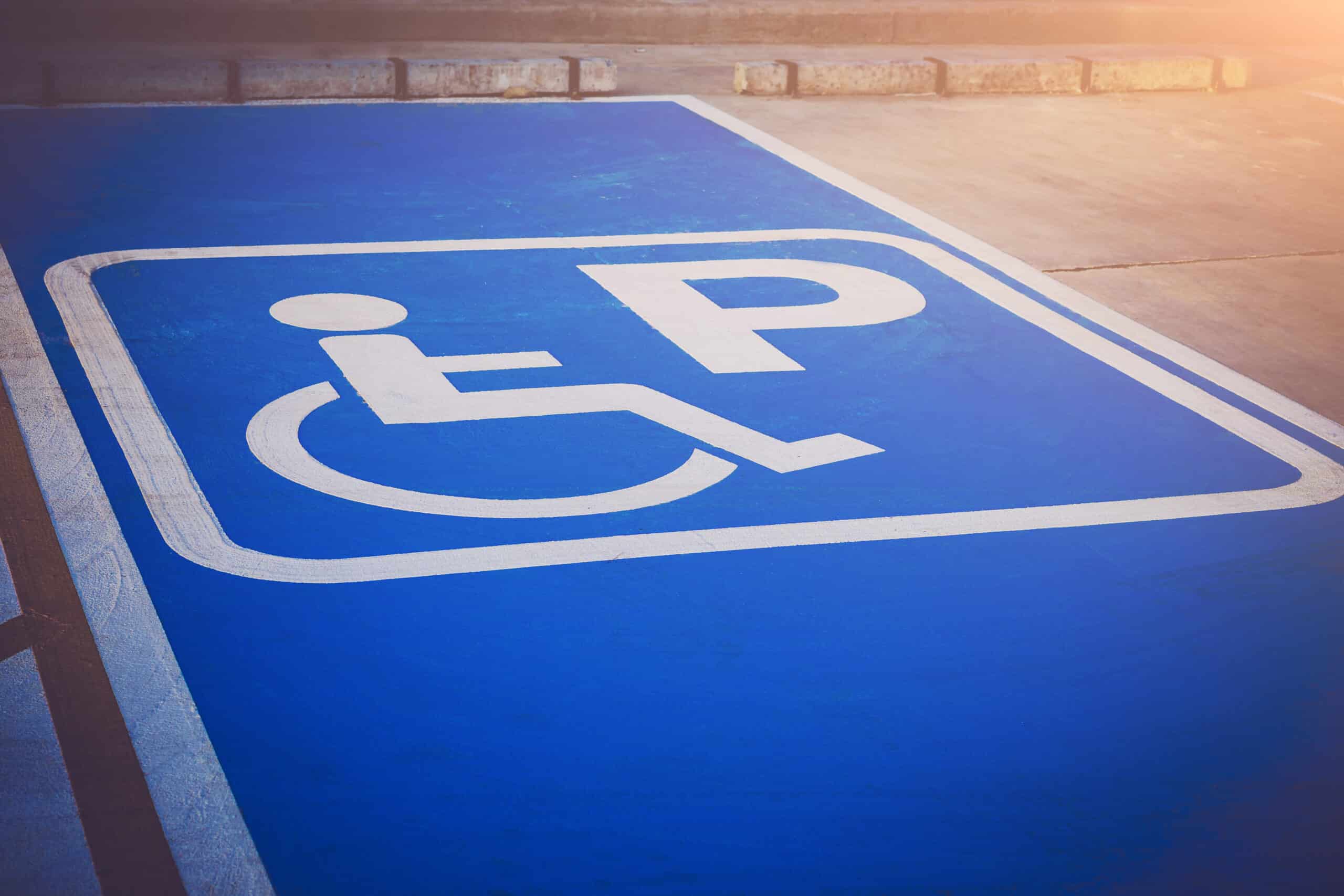
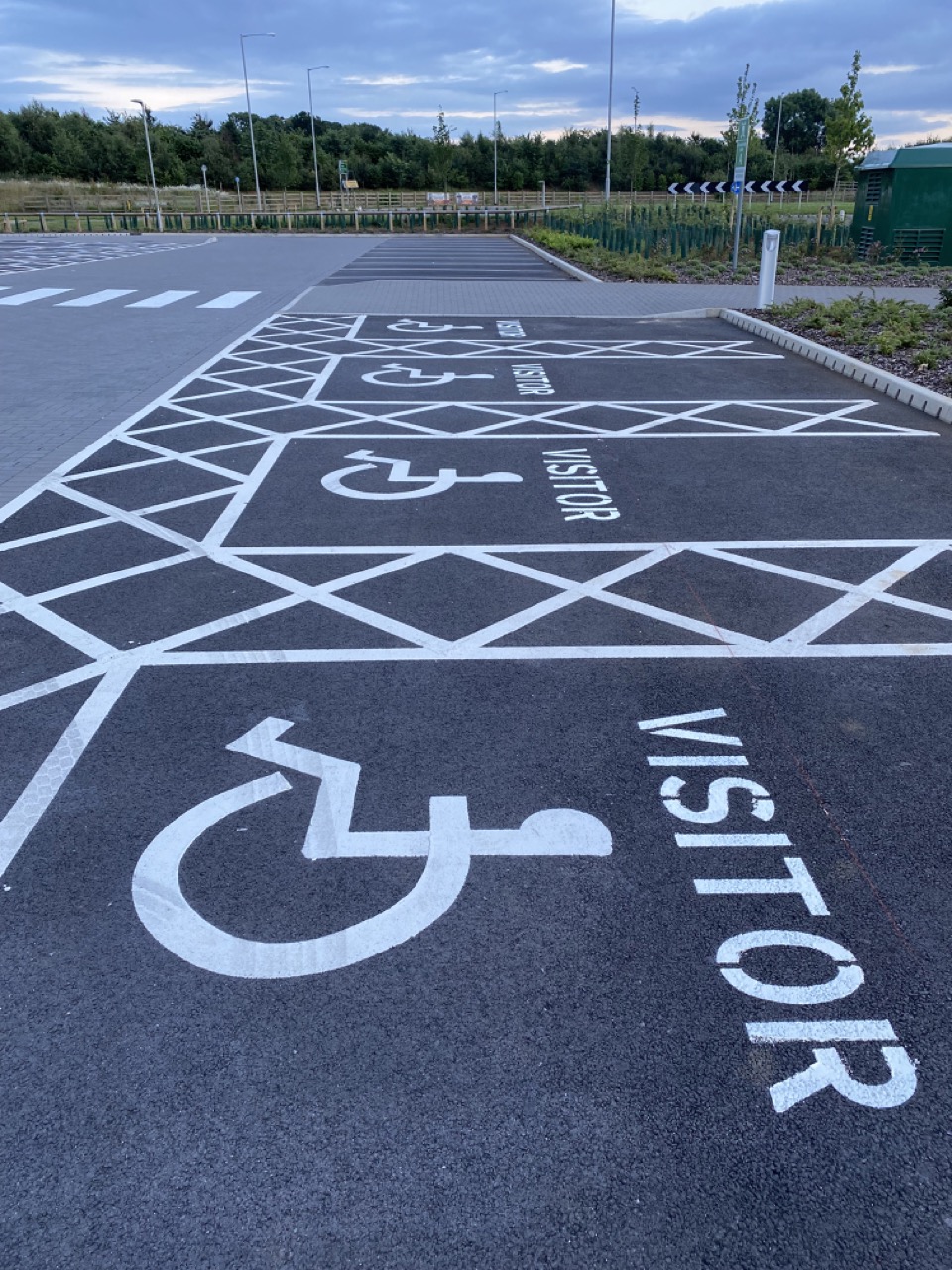
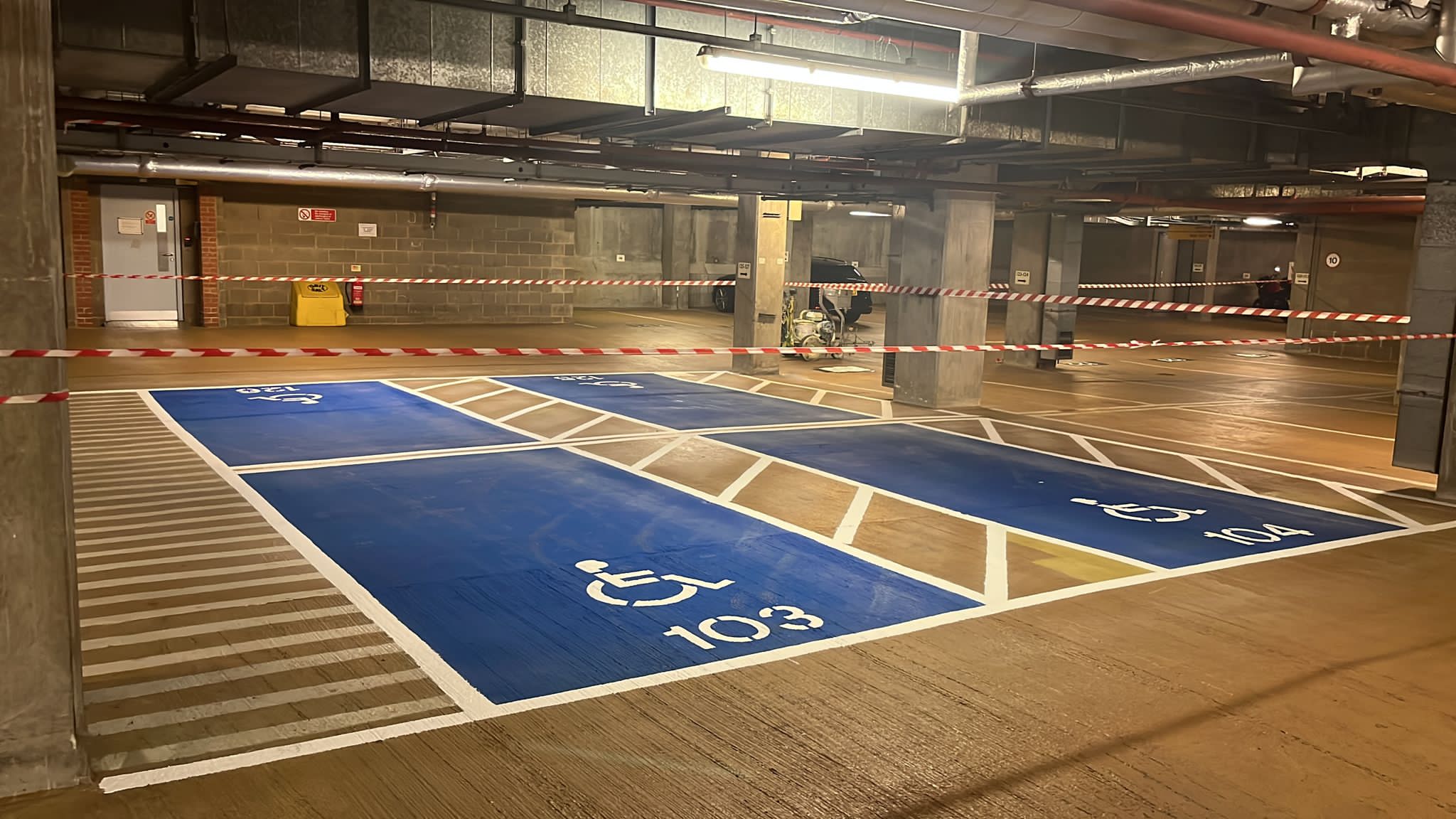
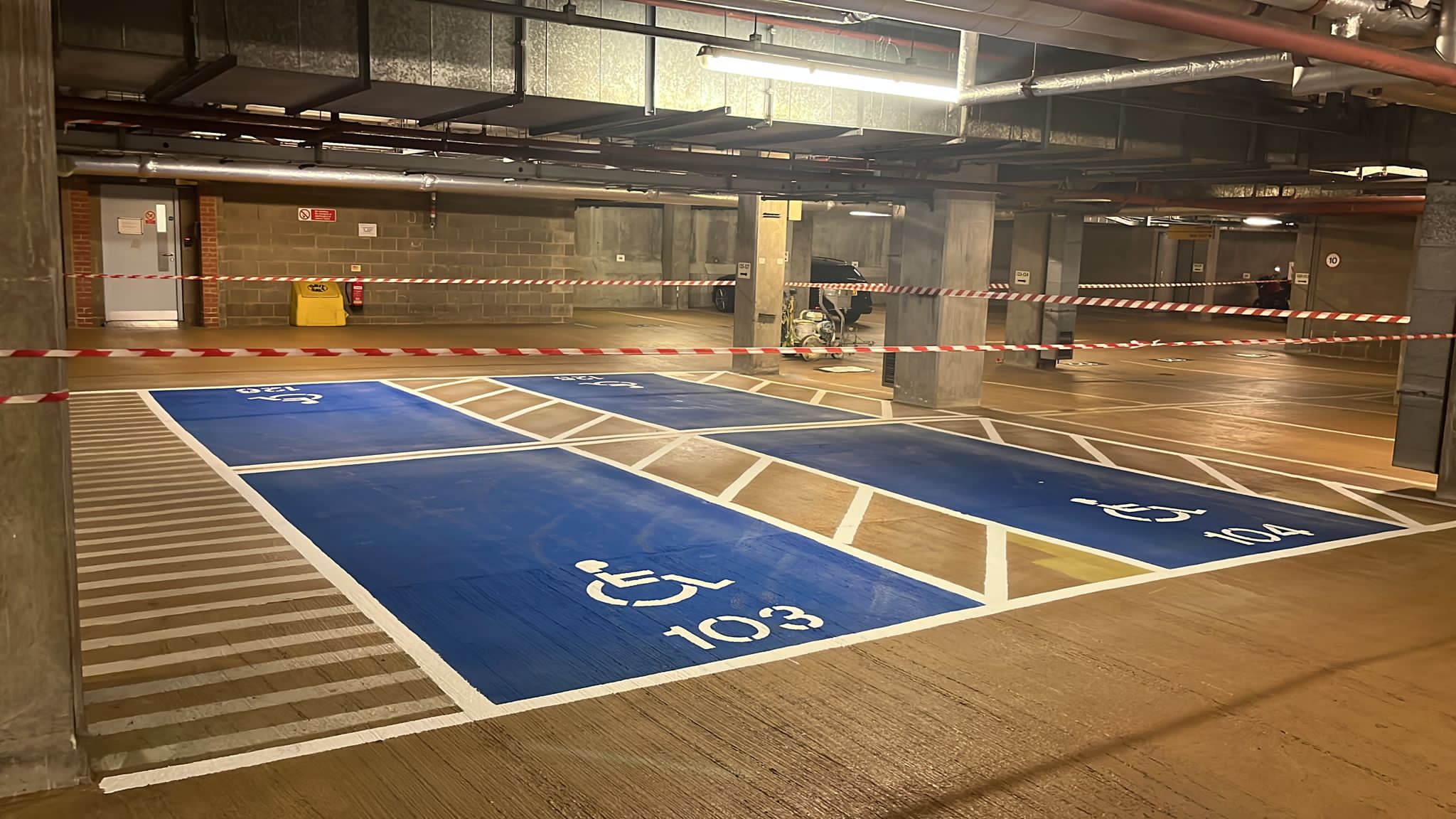
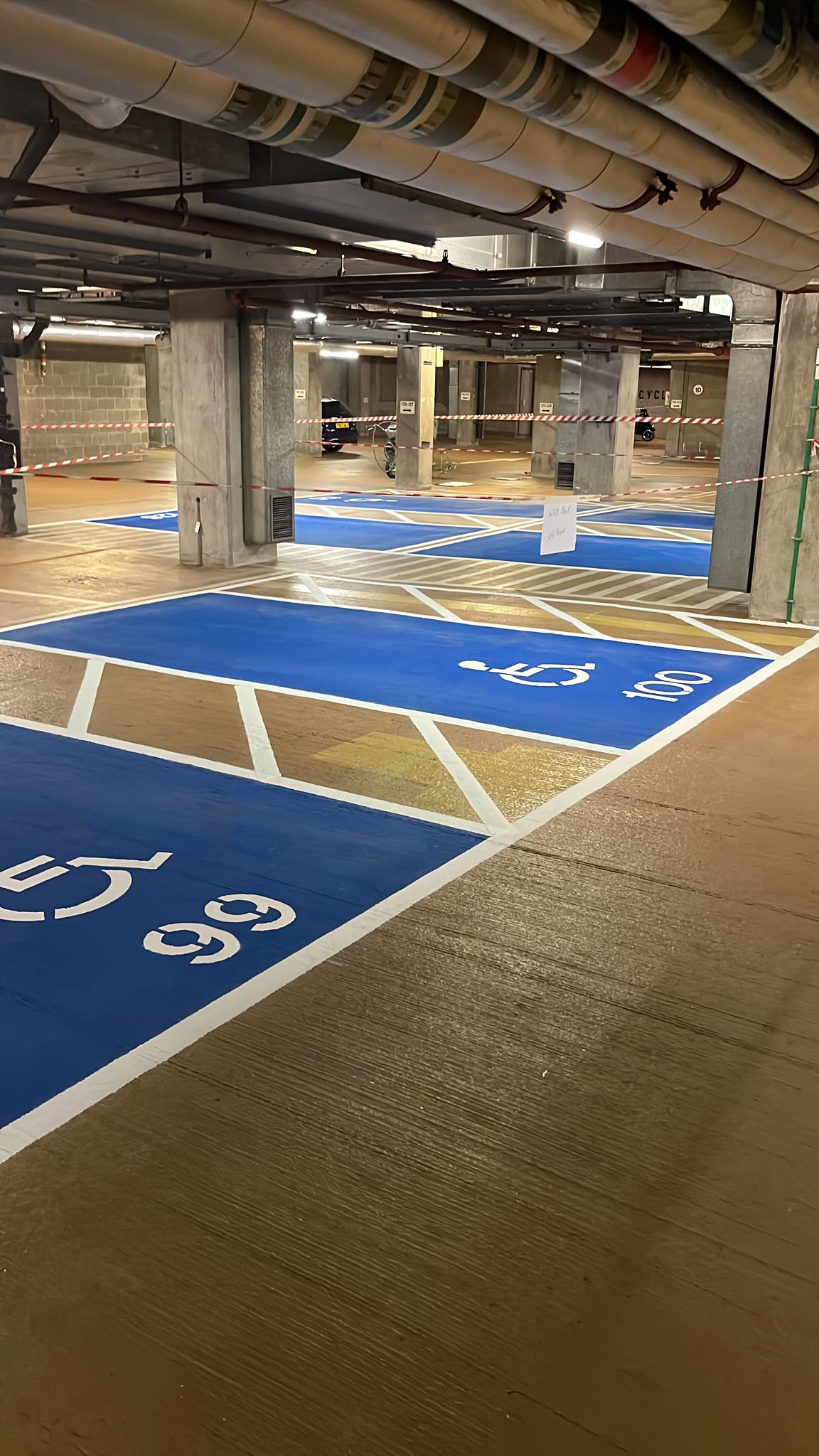
Check out how disabled parking bays look once installed on site.
Requirements and Compliance Guidance
Accessible parking must follow defined guidance to ensure it serves its purpose effectively. This includes both the number of bays required and their layout on the surface.
In practice, one of the biggest issues across UK car parks is that any disabled bays no longer reflect how the site is actually used. Bays may be too narrow, hatching can become worn or obstructed and layouts are sometimes positioned without direct access to dropped kerbs or accessible traces. Older layouts may also fail to reflect changes made to the entrance, traffic routes or pedestrian movement.
The Equality Act 2010 places an ongoing responsibility on employers and building managers to make reasonable adjustments for disabled users and disabled parking provisions are one such responsibility. BS 8300:2018 is commonly used as the recognised benchmark for accessible parking layouts in the UK. While it is not legislation itself, courts and tribunals regularly use British Standards as the reference point for what a reasonable operator would be expected to provide.
As general guidance, workplace parking provisions are typically based on 1 disabled parking space per disabled employee, plus 2 bays or 5% of the total capacity (whichever is greater). For shopping, recreation and leisure facilities, guidance generally increases to 3 bays or 6% of the total capacity (whichever is greater).
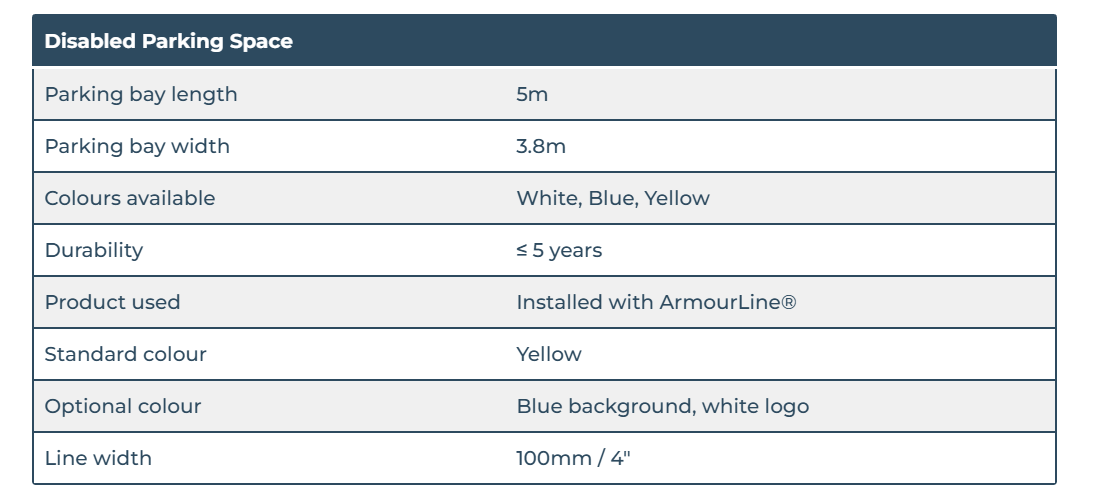
Final layout still depends on how the site operates, where entrances are located and how access routes function across the car park. At Line Mark, we help you sort this out. All disabled parking line markings are applied using the ArmourLine® ultra-durable system, designed to maintain clarity and performance under regular traffic. This ensures that the layouts on disabled parking bays remain intact and continue to function in the long run.
| Disabled Parking Space | |
|---|---|
| Parking bay length | 5m |
| Parking bay width | 3.8m |
| Colours available | White, Blue, Yellow |
| Durability | ≤ 5 years |
| Product used | Installed with ArmourLine® |
| Standard colour | Yellow |
| Optional colour | Blue background, white logo |
| Line width | 100mm / 4″ |
Dimensions for Accessible Parking Spaces
Disabled parking spaces follow a standard format so they can be used safely and consistently across different sites.
A typical layout includes a 2.6 m-wide x 5 m-long bay, plus 1.2m access hatching around the bay (3.8m total width), a central disabled symbol and a 100mm line width.
These dimensions are set up before marking begins, so each bay is positioned correctly. Guidance on the number of bays required will vary depending on the car park’s size and use. The table below outlines the general requirements:

For a more detailed breakdown, please see our full guide on Parking Space and Dimensions (PDF) or speak with our professional today.
Disabled Parking Marking Options and Finishes
The format of disabled parking bays can vary depending on the layout and visibility requirements. The table below outlines the standard and full colour options used.
| Feature | Standard Disable Bay | Full Colour Disabled Bay |
| Line Colour | Yellow | Blue Background |
| Disabled Symbol | Yellow | White |
| Typically Use | Default format accesses most sites | Used where a strong contrast is required |
| Layout Suitability | Suitable for full hatching | Usually used where hatching is limited |
Colours available include white, yellow and blue, while the choice of finish depends on how the bay will be used within the car park and how clearly it needs to be identified once the site is operational.
Disabled Parking Layouts Across Different Site Types
Disabled parking spaces are positioned based on how each site operates, but they must also meet UK accessibility guidance, such as BS 8300. This means correct bay sizing, clear access zones and a proper proximity to entrances.
At Line Mark, layouts are planned on-site so that these requirements are applied in a way that fits the actual flow of the car park.
Retail and Commercial Sites
In retail and commercial environments, UK guidance requires disabled bays to be located as close as possible to accessible entrances, with step-free access and clear routes into the building. Bays must also include the correct access hatching, typically 1.2m of yellow hatching around the bay, so wheelchair users and passengers can enter and exit vehicles safely.
At Line Mark, we position accessible parking spaces directly along main approach routes to the entrance, ensuring they remain usable even during peak hours. Markings are set out with clear spacing and strong visibility so they can be identified quickly within high-traffic layouts.
Warehouses and Industrial Sites
At industrial sites, accessibility requirements still apply, but placement must also account for operational risks. Disabled bays should be located away from loading zones, HGV routes and active work areas, while maintaining safe pedestrian access to the building. We at Line Mark understand that and plan these layouts by separating disabled parking from heavy vehicle movement and defining clear pedestrian routes from the bay to the entrance. This reduces interaction with operational traffic while keeping access simple.
Public and Multi-Use Spaces
In public and multi-use spaces, we install layouts that prioritise immediate readability, as guidance here focuses on clarity and usability for all users, including those unfamiliar with the layout. Disabled bays must be clearly marked, easy to identify, and positioned to provide the shortest and safest route to key access points. As a result, we paint handicap parking markings with clear symbols and consistent dimensions so they can be recognised with ease.
School
In school environments, disabled parking bays need to support safe access during busy drop-off and pick-up periods when vehicle and pedestrian movement increases significantly. Bays should be positioned close to accessible entrances while avoiding conflict with parent parking areas, crossings and pedestrian routes. At Line Mark, disabled parking layouts for schools are planned to maintain clear access, improve visibility and support safer movement across the site during peak traffic periods.
Healthcare Environments
In healthcare settings, accessibility is under even greater scrutiny due to the number of patients, visitors, and mobility-impaired users who rely on the car park every day. Disabled bays must provide direct, practical access to entrances, pathways and dropped kerbs without creating unnecessary travel distances. At Line Mark, healthcare parking layouts are designed around traffic flow, ambulance access, pedestrian safety and day-to-day operational demands to help maintain clear, functional and compliant parking provision.
Durable Disabled Parking Line Marking with ArmourLine®
All disabled parking spaces are installed using the ArmourLine® system, developed to deliver consistent, long-lasting markings across different environments.
The process begins with proper surface preparation followed by the application of high-performance materials suited to the traffic levels and surface type. This ensures strong adhesion and a clean, uniform finish across the layout. Because the layouts are applied using controlled methods, they maintain their visibility and structure for long, even in areas subject to frequent use.
SuperLine® Warranty and Maintenance
To maintain the condition of disabled parking bays in the long run, Line Mark offers the SuperLine® extended warranty.
This includes repairs to damage markings, cover for product-related issues and scheduled maintenance visits. This allows marking to remain clear and usable without requiring full reapplication, which is very useful in high-traffic areas.
Line Marking Installation Process At Disabled Parking Spaces
Disabled parking line marking is carried out through a structured process to ensure each bay is positioned accurately and functions as intended once in use. The process begins with a site assessment, during which each bay is measured and set out to align with access points, entrances and surrounding traffic flow.
This is followed by surface preparation to ensure proper adhesion before markings are applied with professional-grade equipment to maintain consistent line spacing and finish.
Final checks are carried out once installation is complete to confirm clarity, alignment and overall layout accuracy. To see how this works in practice, watch our installation process below:
The Problems Car Park Operators Actually Deal With
Essential Bays Cannot Be Closed For Long
Disabled parking layouts need to be installed or upgraded while the site remains fully operational. In many cases, bays cannot simply be closed off for long periods because they provide primary access to emergency healthcare facilities, retail units or public buildings. At Line Mark, installation planning is structured around maintaining accessibility throughout the work. Where bays are already in use, the layout and scheduling are adjusted to ensure accessibility is not compromised during installation.
Car Parks Still Need to Operate
Most sites cannot stop traffic flow while line marking work is taking place. Vehicle access, deliveries, and pedestrian movement must continue safely, especially when disabled parking spaces are located close to entrances. In such places, we use MMA systems to enable a quick return to use. This helps reduce disruption and installations are completed in controlled sections, with temporary layout adjustments used where required.
Safe Access Routes Must Stay Clear
During installation, pedestrian routes between disabled bays, dropped kerbs and entrances can quickly become confusing or obstructed. We use temporary layout adjustments and traffic management measures during installation to maintain safe pedestrian routes between disabled parking bays and accessible entrances, ensuring accessibility throughout the work and minimising disruption to site users.
Why Choose Line Mark for Disabled Parking Line Marking
At Line Mark, disabled parking line marking is delivered as part of a structured service that combines site assessment, layout planning, installation and ongoing maintenance into a single workflow. Bays are positioned to support direct access to the entrance, with layouts designed to remain clear and usable under daily conditions and are not treated as standalone markings.
All work is carried out in line with recognised UK guidance, including BS 8300 for accessibility and BS EN 1436:2018 for visibility and performance. Materials were selected based on site usage, with systems such as MMA used where faster curing and increased durability are required, particularly in high-traffic areas near entrances.
We support each project with an on-site survey to assess requirements, measure the set-out before installation and provide a clear quotation that defines the scope. Markings are applied using the ArmourLine® system for consistent results, with the option to include SuperLine® warranty and maintenance, providing ongoing support through inspections, repairs and re-marking where needed.
Get a Quote for Disabled Parking Line Marking
Connect with us to discuss requirements or request a quote
Book a free site survey
We assess your layout, access points and disabled parking requirements on-site before installation.
Receive a fixed quotation
Clear pricing and a defined scope based on your car park and usage.
Schedule your installation
Please book a date that fits your operations, including any required re-markings.
Start your project
Submit your details online or speak to our team to get started.
Gallery
FAQs
Where should disabled parking spaces be located in a car park?
Disable parking spaces should be positioned as close as possible to accessible entrances, with step-free routes into the building. Placement should allow direct access without crossing active traffic routes where possible.
Do disabled parking bays need hatching on both sides?
Access hatching is typically required to allow safe entry and exit from vehicles. The exact layout may vary depending on space constraints, though at least one side should provide sufficient clearance for accessibility.
What colour should disabled parking spaces be?
Disabled parking bays are usually marked with yellow lines and a disabled symbol. In some cases, a blue background with a white symbol is used to increase visibility, particularly where contrast is needed.
Can disabled parking spaces be added to an existing car park?
Yes, the existing layout can be updated to include disabled parking bays. This may involve removing or adjusting current markings to create the correct dimensions and access zones.
Do disabled parking spaces need specific dimensions in the UK?
Yes, disabled bays must follow standard dimensions and include wider bays and access hatching to allow safe movement around the vehicle.
Can faded disabled parking markings be repainted?
Yes, existing bays can be referred to through repainting or remarking. Surface preparation is carried out beforehand so that the new marking adheres properly and remains visible.

12th Jan
Professional Staff
Professional Staff - clean and tidy - Good prices - Great job - this company...
Steve Wescott
20th Dec
Excellent Service
Line-mark were a very easy company to deal with. From the sales, admin all the...
L. Groves
10th Dec
Fantastic
Fantastic service from sales to the staff painting the lines. Thanks Neil HTS
MTS Mead Park
22nd Nov
Excellent Service
Excellent service from the initial site visit through to completion of our lines. Every member...
Barney
1st Oct
Great service from the original enquiry
Great service from the original enquiry through to the finished job! A friendly and helpful...
Mark Myles
26th Sep
Hevey Northampton and Blackstar yard line marking refurbishment.
I would like to thank Lee and Jarrod for their professional approach , work ethic...
Blackstar
26th Sep
The guys who arrived on site were…
The guys who arrived on site were excellent. Helpful, communicative and nothing was too much...
Calor Gas
18th Jul
A1 Service
great service, operatives were very professional, they integrated well with our warehouse staff so work...
KS
13th Jun
Great Team
Great team. Made the process very simple and easy. Extremely friendly and helpful. Will definitely...
Saj
13th Oct
speedy and professional
The re-lining of our car park and access road was carried out in a speedy...
Chris South
6th Oct
Very professional
Very professional service from start to implementation. The two teams that arrived on site were...
Louis Bertuzzo
15th Sep
Excellent
Excellent, quality product & service from quote, through to survey and installation
Stefan Tobolik
15th Sep
1st class job for Winkhaus
1st class job
Eddie Fitzpatrick
15th Sep
Excellent service from the very..
Excellent service from the very beginning. Came across a few issues during the work but...
Damian Stafford
15th Sep
Car parking bays and EV boxes
Very professional service from start to finish. Extremely happy with the results. Our car park...
Martin Griffiths
15th Sep
Excellent service, very professional from start to finish
Excellent service, very professional from start to finish
Jim – Marlec
15th Sep
Haas F1 Team line markings
I recently used Line-Mark to re-paint the lines for our front and rear car parks...
Simon Wood
15th Sep
Quick & Easy
70 vehicle spaces and a few other markings were completed in no time at all....
Nick Wyatt
15th Sep
Would recommend.
Great service from first contact to completion, would recommend.
Chris Dodman
15th Sep
5* Line Marking
We received a competitive quote for works following an online submission. The quote seems too...
Mehmet Hussein
Putting Lines all over the Country

Line Removal
Get a quote
 Check if we cover